



Science
Subject Leader: Mr Langley
Our school Science vision and principles
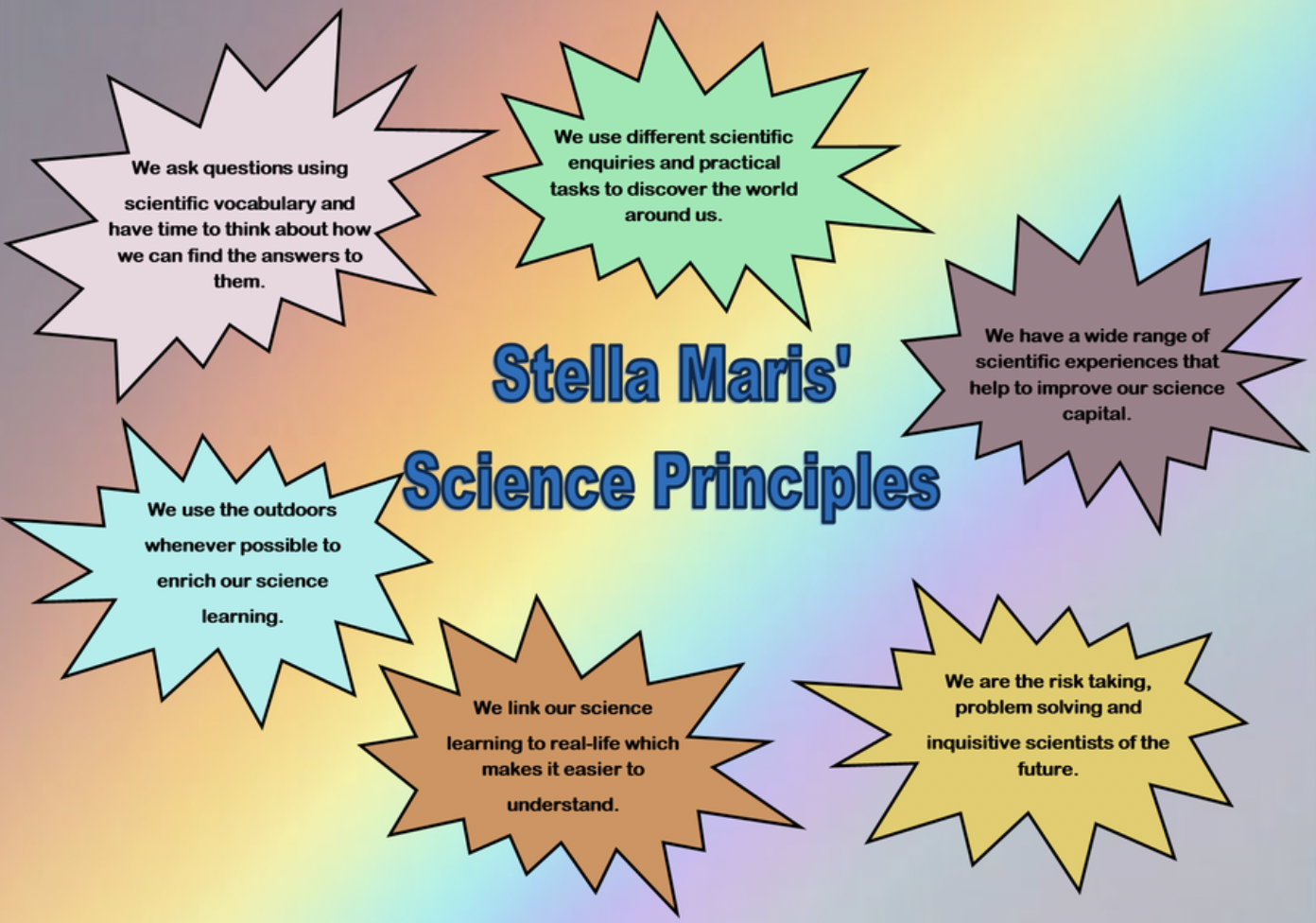
Above you will be able to read our science vision, it is made up of the principles on how the children and staff feel that science should be learnt and taught here at Stella Maris.
There are two main strands to the teaching of Science in our school. The first is to ensure that the children are taught the specific scientific knowledge set out in the National Curriculum, and covering topics including:
- plants
- animals including humans
- evolution and inheritance
- living things and their habitats
- electricity
- forces
- Earth and space
- the seasons
- light and sound
- materials
The second is to encourage a spirit of curiosity about the world around them and to develop the skills of scientific enquiry: to be able to predict what will happen in a practical activity, to conduct a fair or comparative tests and to record their results accurately, describing clearly what they have discovered.
As part of this, children become increasingly aware of the type of scientific enquiry that they are carrying out or need to carry out to answer their scientific questions.
The types of scientific enquiry are:
- Observation over time
- Research
- Pattern Seeking
- Comparative and Fair testing
- Classifying and sorting
- Problem solving
In the process of learning about Science we also try to teach the children to appreciate the magnificence of the created world and to develop an appropriate respect for it and an awareness of issues concerning pollution, the environment and sustainability.
Science - Intent
The Science curriculum at Stella Maris aims to give all children a strong understanding of the world around them, providing them with specific skills and knowledge, and helping them to think scientifically and gain an understanding of scientific processes. It also develops their understanding of the uses and implications of Science, today and for the future.
Our intention is to develop them into budding scientists, who care for the world around them, are curious about what they see and experience, and are able to use science to understand how human activity impacts on the planet and how we can carry out our duty of care for God’s creation.
Science - Implementation
A range of science topics is taught in every year group, linked where appropriate to a Power of Reading book that is the focus for the term (for example, studying Rocks in Year 3 when the Power of Reading Book is A Pebble in my Pocket). Scientific enquiry skills are embedded in each topic and these are revisited and developed throughout their time at school. Topics such as Plants or Materials, for example, are taught in Key Stage One and studied again in further detail throughout Key Stage Two. This model allows children to build upon their prior knowledge and increases their enthusiasm for the topics, providing progression in skills and knowledge, and developing mastery.
All children are encouraged to develop and use a range of skills including observations, planning and investigations, as well as being encouraged to question the world around them and become independent learners in exploring possible answers for their science-based questions. Specialist vocabulary for topics is taught and built up, and effective questioning to communicate ideas is encouraged.
Science - Impact
Our children leave Stella Maris with a well-developed curiosity about the world around them, the skills needed to ask probing scientific questions and to seek appropriate answers to them, and a sense of responsibility for the environment and the role of humanity in helping to preserve it.
Our Science curriculum starts the children off on a learning journey that ensures they are ready for their next steps at secondary school with the skills needed to be focused and articulate as scientists. In addition, they leave our school with powerful memories from the wide range of experiences they have encountered here.
The Primary School Quality Mark
The Primary School Quality Mark programme ensures effective leadership of science, enables schools to work together to share good practice and is supported by professional development led by local experts. It encourages teacher autonomy and innovation while at the same time offering a clear framework for development in science subject leadership, teaching and learning. Schools that achieve PSQM demonstrate commitment and expertise in science leadership, teaching and learning.
The Primary Science Quality Mark is led by the University of Hertfordshire, School of Education in collaboration with the Primary Science Teaching Trust.
Associate Professor Jane Turner, PSQM National Director said:
“There was never a more important time for primary children to have a high-quality science education. The Coronavirus Pandemic has made everyone aware of the impact of science on our daily lives. Primary schools have an important role to ensure that children understand how science works and keeps us healthy and safe. Schools that have achieved a Primary Science Quality Mark have demonstrated a significant commitment to science teaching and learning, even at this challenging time for schools. The profile and quality of science in each awarded school is very high. Children are engaging with great science both in and outside the classroom, developing positive attitudes towards science as well as secure scientific understanding and skills. Science subject leaders, their colleagues, head teachers, children, parents and governors should be very proud.”